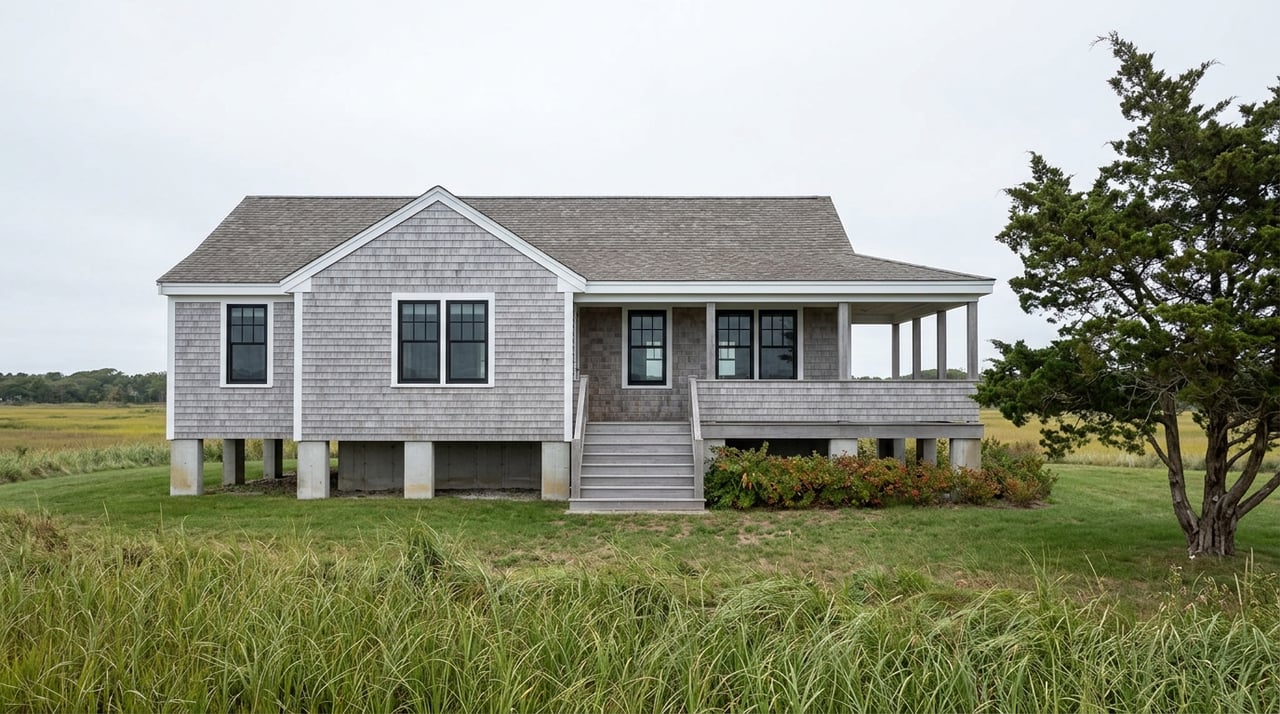
Westport Waterfront Closings Now Have Three Flood Checks. The New State Law Covers One.
September 17, 2026
September 17, 2026
If you are buying or selling on the Saugatuck River, at Compo, or anywhere along Beachside Avenue this fall, you are closing under a disclosure regime that did not exist a year ago. Connecticut's Public Act 25-33 took effect July 1, 2026, adding a new Flood Risk Awareness section to the state's residential condition disclosure report and requiring mortgage lenders to send a written flood insurance notice at least ten days before closing. At the same time, Westport's own flood maps are moving. The town's planning department currently lists its FEMA map update, part of the broader Saugatuck River watershed remapping project, as anticipated for adoption this fall. Two systems that rarely change are both changing in the same closing season.
It would be easy to read that as good news: the state finally requires flood disclosure, the town is finally updating outdated maps, problem addressed. It isn't. The new law adds paperwork. It does not add verification. And Westport's own enforcement records show the gap that paperwork leaves behind sits in a place no disclosure form asks about at all.
The Flood Risk Awareness section added by PA 25-33 asks the seller two specific things: whether the seller or a previous owner received FEMA, SBA, or other federal or state disaster assistance for flood damage to the property, and whether the structure has experienced water penetration or damage. Both are self-reported. A seller who genuinely does not know can answer "unknown," and many do, because plenty of longtime Westport owners have never pulled their own flood zone designation or ordered an Elevation Certificate.
The form itself is candid about its limits. Right on the document, Connecticut's own disclosure language states that "FEMA flood maps are not designed, nor intended to be, a reliable tool for buyers to assess a property's flood risk," and that a property does not have to be near water or in a mapped zone to flood. The state wrote the caveat directly into the form buyers are meant to rely on.
There is also a penalty worth knowing if a seller skips the report entirely: under existing Connecticut law, a seller who fails to furnish a residential condition report owes the buyer a $500 credit at closing. That covers a missing form. It does not cover an inaccurate one, and it does nothing for the two questions that matter most on Westport's waterfront: what a home's insurance will actually cost, and what a buyer is legally allowed to build.
Treat the new law as covering exactly one of three separate diligence layers a Westport waterfront transaction actually needs.
| Layer | What it tells you | Who provides it | What it misses |
|---|---|---|---|
| Seller disclosure (PA 25-33) | Seller's knowledge of flood zone status, prior federal disaster assistance, water damage history | Seller, self-reported | Independent verification, current FEMA zone accuracy, permit compliance |
| Elevation Certificate | Finished floor elevation relative to Base Flood Elevation, the number insurers actually price against | Licensed surveyor, ordered separately | Renovation restrictions, dock or bulkhead permit status |
| WPLO / Conservation Commission permit history | Whether existing structures, walls, or additions were built with proper wetlands and waterway permits | Westport Conservation Department records | Insurance cost, flood zone designation |
A buyer who only reads the disclosure form is unprotected on the second and third rows. A buyer who only checks the FEMA flood zone map is unprotected on the third. None of the three, taken alone, tells the full story.
Westport's shoreline carries a mix of AE and VE flood zones, and the split follows water exposure more than neighborhood name. Properties along the sheltered Saugatuck River and its protected coves are typically classified under AE zones, still a designated Special Flood Hazard Area requiring flood insurance for any federally backed mortgage. Homes facing the open coastline of Long Island Sound, including parts of Compo and Saugatuck Island, more often fall into VE zones, where wave action triggers stricter construction standards, including elevation on pilings for new construction or substantial improvements.
But the zone label alone does not price the policy. The Elevation Certificate does. It is a survey document showing exactly how high a home's finished floor sits relative to the Base Flood Elevation, and insurers use that number, not the zone name, to set premiums. A few inches of difference in recorded elevation can move a premium by thousands of dollars a year. Ask for a current Elevation Certificate before finalizing an offer, not after.
This matters more this fall because the ground under those zone labels is shifting. Westport's remapping project, part of the same regional Saugatuck River watershed study that has pushed finalization timelines later across several Fairfield County towns following the 2025 federal government shutdown's disruption to FEMA's schedule, means a parcel's official zone this September may not be its zone by year's end. A seller's disclosure answer of "no" to flood hazard area status could be accurate today and stale by closing.
Here is the layer that catches people off guard, because nothing in state disclosure law asks about it. Westport regulates activity near wetlands and watercourses independently of FEMA through its Waterway Protection Line Ordinance and Inland Wetlands and Watercourse Regulations. Depending on the activity, setbacks from the wetland boundary run from 15 to 30 feet: general landscaping and grading require a 20-foot buffer, walls specifically need to sit more than 30 feet from the wetland line without Conservation Commission approval, and the Waterway Protection Line itself is set at a fixed distance from the surveyed wetland boundary.
Westport's Conservation Commission records make clear this is not a theoretical risk. Recent enforcement actions include a cease and correct order at a Sturges Commons property for a stone wall and grading built within the wetland setback that exceeded the scope of an approved pool and patio permit, and a separate show cause hearing over stone walls, walkways, fences, and outbuildings built without permits in the wetland review area at a Devon Road property. Renovation and elevation projects on Bermuda Road and Sea Spray Road, both explicitly filed as work within the WPLO area of the Saugatuck River, show how often FEMA-compliance renovations and wetlands permitting intersect on the same project.
If a listing mentions room for a pool, a larger patio, or an addition on a waterfront lot, that claim is subject to Conservation Commission approval regardless of what the flood zone says. None of this shows up in the new state disclosure form, because the form asks about flood zones and water damage, not local wetlands permitting history.
Even a dock that has been in daily use for years is not automatically fully permitted, and existing use does not guarantee the rights transfer cleanly to a new owner. Connecticut regulates the land waterward of the Coastal Jurisdiction Line, and any dock, pier, or bulkhead needs valid permits from both Westport's Flood and Erosion Control Board and CT DEEP. Verifying that paperwork is a separate task from checking a flood zone or reading a disclosure form, and it belongs on the list before an offer goes in, not after an inspection contingency has already been waived.
Does the new disclosure law apply to inland Westport homes too? Yes. The Flood Risk Awareness section is part of the standard statewide residential condition report and applies to any residential sale of four units or fewer, regardless of proximity to water.
What happens if the flood zone changes between contract and closing? Nothing in the new law requires either party to update disclosure mid-transaction. That is precisely why an independent Elevation Certificate, ordered close to closing rather than relied on from an old survey, matters more than the zone label on record at the time an offer is signed.
Who typically pays for an Elevation Certificate? It varies by negotiation. Some sellers order one proactively to support pricing and marketing, others leave it to the buyer during due diligence. Either way, request it early enough that the result can still inform the offer.
Waterfront transactions in Westport carry more moving pieces this year than the disclosure form alone suggests. If you are weighing an offer on the Saugatuck River, at Compo, or anywhere the town's incoming flood maps and wetlands ordinance both apply, the team at LM Homes Team has spent years coordinating exactly this kind of due diligence for Fairfield County buyers and sellers. Schedule a Consultation to talk through what a specific property actually requires before you write an offer.
Stay up to date on the latest real estate trends.




We believe exceptional results come from thoughtful planning, trusted relationships, and personalized service. By working together as one seamless team, we provide comprehensive guidance, proactive communication, and unwavering advocacy to help you achieve your real estate goals with confidence.
199 POST ROAD EAST WESTPORT, CT 06880