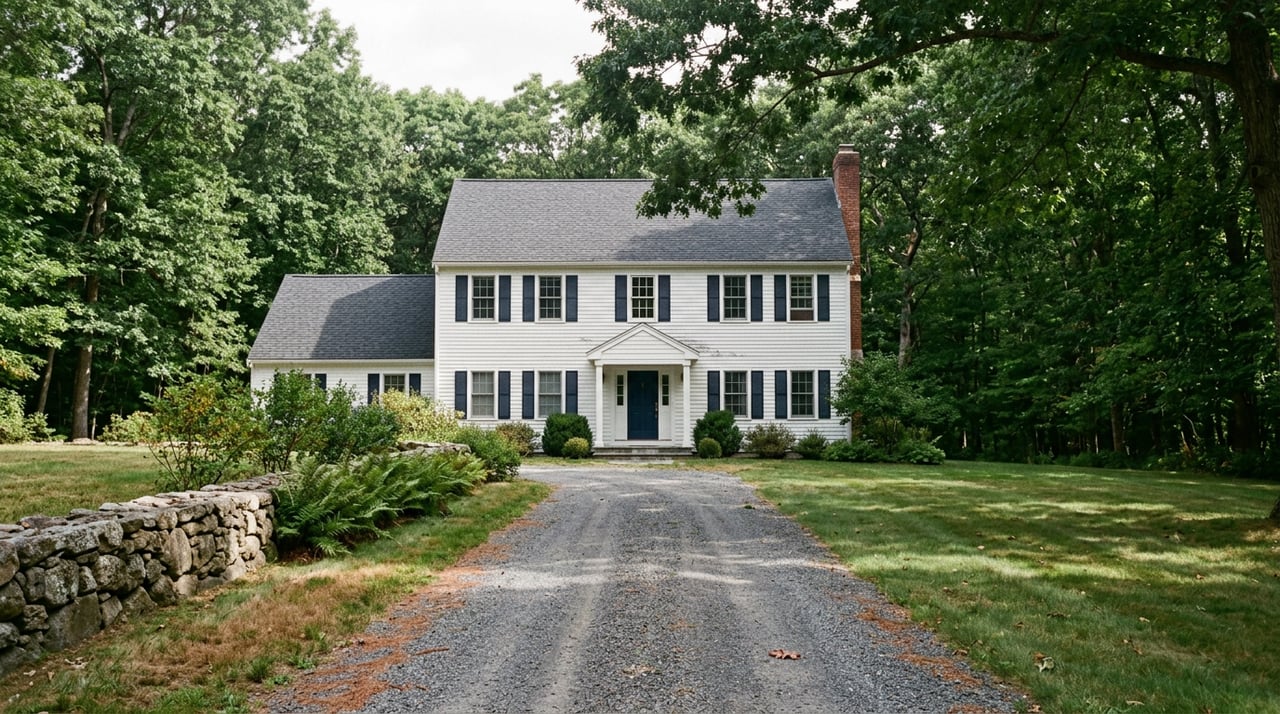
What Weston's Median Price Doesn't Tell You
August 6, 2026
August 6, 2026
A buyer comparing Weston to Westport or Wilton on a listing portal is looking at three numbers that describe three different transactions. The median tells you what closed. It does not tell you what closing in Weston actually involves, why the days-on-market figure moves the way it does, or why two homes with identical asking prices can carry wildly different carrying costs. The mechanism behind all of that is a single zoning designation the town adopted in 1980 and has protected ever since: R-2A, the Two-Acre Residential and Farming District. Understanding R-2A is the difference between reading Weston's market and misreading it.
Before we talk about price, talk about the transaction itself. Weston is almost entirely R-2A, and R-2A properties are almost entirely served by private wells and on-site septic systems. That means every purchase in town includes a due-diligence layer that a Westport downtown buyer or a Norwalk condo buyer never touches.
The relevant authority is the Westport-Weston Health District, which shares administrative infrastructure with Easton and operates out of 225 Center Road in Easton. It reviews septic construction, alteration, and repair through a permit process with published fees: $450 for a new or total replacement system, $200 for a leaching or tank repair, and $125 for a B-100A review used when a homeowner wants to add bedrooms or expand. Those numbers are not the cost of the work. They are the cost of the paperwork that governs the work.
A buyer who has never owned a septic system tends to underestimate three things:
None of this makes Weston a difficult market. It makes Weston a market where inspection week does real work, and where a listing agent who has walked a buyer through septic conversations before is worth the introduction.
The zoning itself, adopted by the Weston Planning and Zoning Commission on January 11, 1980 and codified in Chapter 240 of the town code, is not complicated. It is restrictive by design. The dimensional standards for R-2A read as follows:
Farming is a permitted principal use, with the caveat that no farm structure sits within 100 feet of a property line. Places of worship, private schools, riding stables, and nursery schools are available only by special permit. The full text sits in the Weston zoning code, Article III.
Read the list once and the market picture reorganizes itself. Weston cannot densify. It cannot subdivide meaningfully. It cannot add multifamily by right. Roughly the entire residential base of the town is locked to one house per two acres, and that is what a buyer is actually purchasing when they close on a Weston home.
Now the median makes sense.
Data sources disagree on Weston's headline price, and the disagreement itself is informative. Redfin reported a three-month median sale price of $1.6M through May 2026. Zillow's home-value index for June 2026 sat at roughly $1.36M with a 14-day pending window. Movoto put the July 2026 median list price at $1.42M with 27 days on market. A separate Q1 2026 report from a local analyst logged only 13 single-family closings at a $1,125,833 median with 77 days on market and a 100.7% sale-to-list ratio, down from 103.9% a year earlier.
Those numbers look contradictory. They are not. They are the same market seen through different windows. Weston closes a small number of homes each quarter because R-2A caps supply. When the composition of what closes shifts, even slightly, the median swings hard. The Q1 2026 report captured a quarter where the $500K to $1M bracket produced six closings, up from four the prior year, while the $1M to $2M bracket dropped from seventeen closings to five. Price per square foot moved 2.2% down, to $362. That is not a market losing value. That is a market where sub-$1M inventory happened to clear while larger listings sat, and the median dutifully followed the mix.
Compare Weston to its neighbors and the R-2A premium becomes visible. Wilton runs a median in the low $1M range with a more active resale pace and a Metro-North stop at Cannondale. Westport pushes past $1.8M for comparable square footage and adds a downtown and shoreline access. Norwalk starts well below $700K and offers walkable density Weston has intentionally refused. Weston sits between those markets on price and above all of them on land preservation, with a majority of its total land area permanently protected. A buyer paying the Weston median is paying for scarcity that is written into the code, not into the marketing.
The most misread statistic in Weston is time on market. One aggregator's 110-day figure and Movoto's 27-day figure look incompatible, and the Q1 2026 report's 77-day average sits between them. The reconciliation is straightforward. Weston's buyer pool is smaller and more deliberate than Westport's or Norwalk's. Two-acre properties do not sell on impulse. Buyers visit multiple times, coordinate a wetlands walk, pull septic-as-built records, and confirm what the R-2A envelope allows before they write. That process takes weeks. The sale-to-list ratio has stayed at or above 100% through the 2024 to 2025 stretch and only softened to 100.7% in Q1 2026, which tells you that when Weston homes close, they close near ask. Longer marketing time in Weston is selection, not distress.
There is a second friction worth naming: Weston has no train station. The nearest Metro-North platforms are Westport on the New Haven Line and Cannondale in Wilton on the Danbury Branch. A five-day-a-week commuter typically drives to Westport and boards there. A buyer whose life depends on a walk-to-train morning should be looking at Westport or Wilton, not Weston, and pricing conversations that ignore this filter out the wrong buyers late in the process.
The R-2A envelope, the health district, and the transaction rhythm produce a specific diligence checklist. In order:
Each of these items exists because R-2A exists. None of them appears on a listing sheet.
The Weston median is a compositional artifact of a zoning district that caps supply, filters buyers, and pushes real cost into the diligence phase rather than the list price. A buyer who reads the median as a market signal will misprice both the opportunity and the friction. A buyer who reads the median through R-2A will understand why the number is what it is, why it moves the way it moves, and what they are actually buying when they close.
Does Weston allow accessory dwelling units on R-2A lots? The base R-2A code permits one single-family dwelling per lot as the principal use, with limited accessory provisions. Any ADU plan should be verified against the current version of Chapter 240 and confirmed with Weston Planning and Zoning before purchase, because state and local ADU rules have been in motion in recent years.
How often should a Weston septic system be inspected and pumped? Public guidance from Westport's own stormwater materials recommends inspection every three years and pumping every three to five years. That cadence is a reasonable baseline for a Weston household, adjusted for system age and occupancy.
Is a two-acre Weston lot always subdividable into two buildable parcels? No. Subdivision must satisfy the full R-2A envelope on each resulting lot, including the 170-by-200 rectangle, frontage, and setback rules, plus any overlay constraints. Most existing two-acre lots cannot split.
If you are weighing Weston against another Fairfield County town and want a candid read on what your target price actually buys once the R-2A diligence is priced in, LM Homes Team is glad to walk the numbers with you. Schedule a Consultation.
Stay up to date on the latest real estate trends.

We believe exceptional results come from thoughtful planning, trusted relationships, and personalized service. By working together as one seamless team, we provide comprehensive guidance, proactive communication, and unwavering advocacy to help you achieve your real estate goals with confidence.
199 POST ROAD EAST WESTPORT, CT 06880